Your cart is currently empty!

Categories
Recent Posts
- Custom vs Modular Exhibition Stands in China: Which Is Right for Your Business?
- Best Trade Show Booth Displays for Healthcare and Medical Companies

- Exhibition Booth Construction in China: From 3D Design to Final Installation
- 2027 WorldSBK China Finale | Event Services in China
- How to Find a Reliable Exhibition Stand Builder in China: A Complete Guide for Overseas Exhibitors
Archive
- November 2026
- October 2026
- September 2026
- May 2026
- March 2026
- February 2026
- January 2026
- December 2025
- November 2025
- October 2025
- September 2025
- August 2025
- July 2025
- June 2025
- May 2025
- April 2025
- March 2025
- February 2025
- January 2025
- December 2024
- September 2024
- August 2024
- July 2024
- March 2024
- February 2024
- January 2024
- November 2023
- April 2023
- March 2023
Tags
Air Cargo China BEIJING booth construction booth display ideas booth fabrication booth management booth production brand communication CHINAPLAS CIPS custom exhibition stand builders custom exhibition stand design custom exhibition stands exhibition exhibition booth construction exhibition booth design exhibition booth designers exhibition stand booth exhibition stand builder China exhibition stand builder in Shanghai Exhibition Stand Construction exhibition stand contractor EXHIBITION STAND DESIGN exhibition stand designers and builders expo stand builders expo stand design FPD China 2026 Brand Activation HONG KONG Hotel & Shop Plus Panda Expo Panda Expo China Routes Asia 2026 stand builder SHANGHAI SIAL China 2026 stand builder SNIEC Shanghai Sports Events in China tradeshow booth trade show booth displays tradeshow display tradeshow in guangzhou tradeshow in india tradeshow in japan tradeshow in shanghai tradeshow in vietnam Vinexpo Asia Hong Kong 2026 Exhibition Stand Construction
Social Links
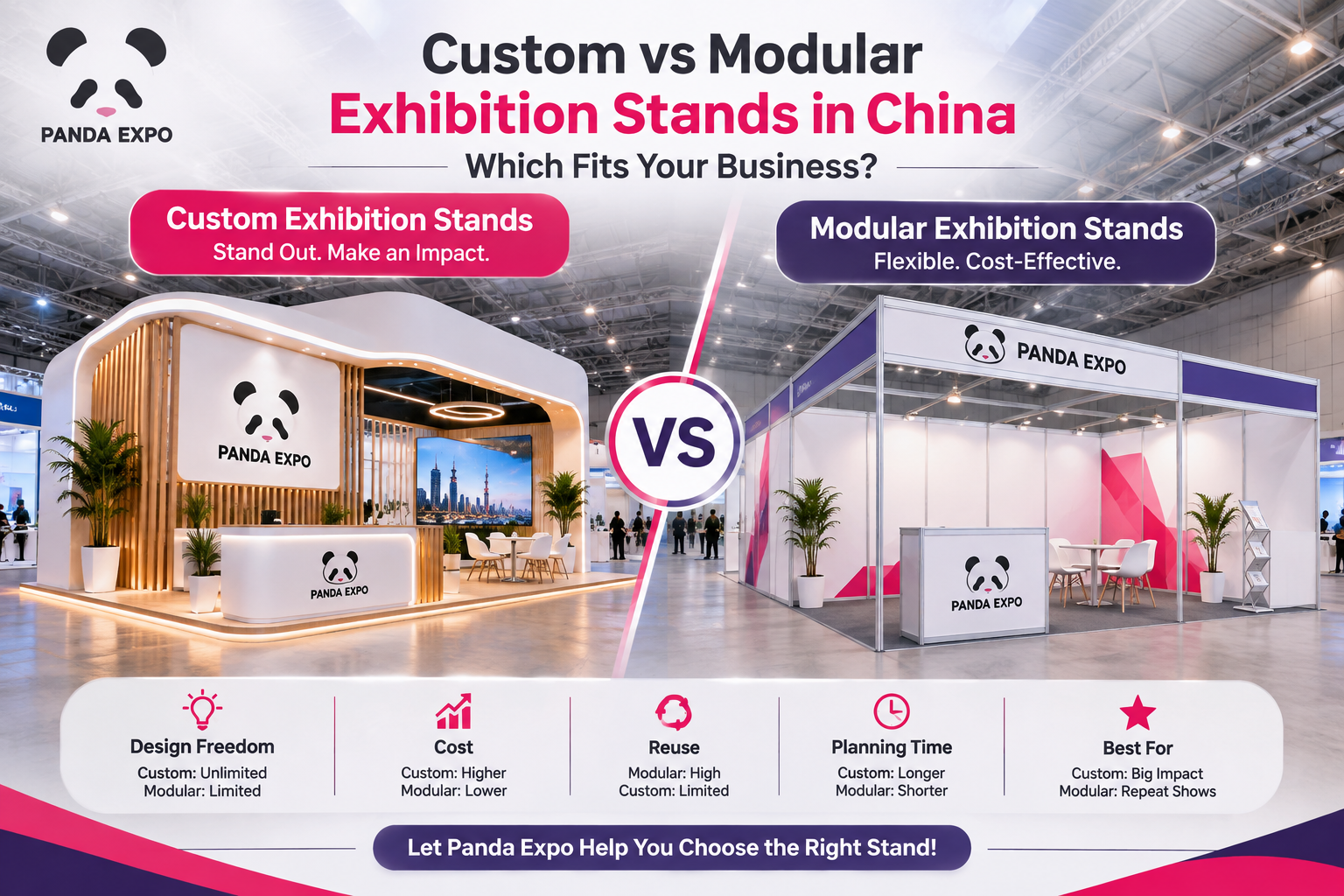

For most international exhibitors in China, the choice comes down to your goals and how often you exhibit. Custom exhibition stands are built from scratch around your brand, so they suit product launches, large raw-space booths and shows where you need to stand out. Modular stands use reusable frame systems like MAXIMA or OCTANORM. They’re quicker to plan, cheaper to repeat and easier to adapt to different booth sizes. Plenty of companies end up using a mix of both.
We build both kinds at Panda Expo China. Here’s how we’d help you decide.
What Are Custom Exhibition Stands?
A custom stand is designed for one brand and, usually, one booth space. Walls, counters, lighting and display units are made to the design instead of picked from a kit. So the stand can take almost any shape the venue rules allow. Curved walls, built-in screens, product plinths cut to size.
The catch? Much of the structure is made for that one booth. Some parts can be stored and reused, but a custom stand is mostly built with a single show in mind.
What Are Modular Exhibition Stands?
A modular stand is built from aluminum frames and panels that lock together. MAXIMA and OCTANORM are two systems widely used in China. Your graphics, lighting and furniture go on top, so the stand still carries your branding.
Because the frame is standard, it can be rearranged. This year’s inline booth can become a corner booth next year, or be split across two smaller stands at two different shows.
The limits come from the system itself. Shapes are mostly straight lines and right angles. Unusual structures are harder to achieve.
Custom vs Modular Exhibition Stands: Side-by-Side
| Custom exhibition stands | Modular exhibition stands | |
| Design freedom | Almost anything the venue allows | Limited by the frame system |
| Brand impact | High, built to stand out | Good, mostly through graphics and lighting |
| Upfront cost | Higher | Lower |
| Cost over several shows | Can stay high if rebuilt each time | Lower, since the frame is reused |
| Planning time | Longer: design, drawings, fabrication | Shorter |
| Reuse | Limited, unless planned for | High |
| Typical booth | Large raw-space, island or corner booths | Small and mid-size booths |
| Best for | Launches and flagship shows | Repeat shows and tight timelines |
We don’t put prices on this table on purpose. Cost depends on booth size, materials, finishes and the show itself, so any figure without your brief would be a guess.
When Custom Exhibition Stands Make More Sense
Go custom if one or more of these sounds like you:
- You’re launching a product or entering the Chinese market, and people need to remember you
- You’ve booked a large raw-space booth, where a system build can look thin
- Your products need built-in features, like screens set into walls, display cases cut to size or a closed meeting room
- This show is the main event in your calendar
Example: A European machinery brand books a large island booth at an industrial show in Shanghai. A custom build gives it a raised product platform, a tall brand wall built up to the venue’s height limit and a closed room for distributor meetings. None of that would come easily from a standard kit.
When Modular Stands Are the Smarter Choice
Modular wins when you exhibit often. If you’re doing several shows in China or across Asia each year, one well-designed kit can travel the whole circuit with new graphics each time.
It also suits smaller booths, short lead times and budgets where a one-off look matters less than steady presence. Reusing the same structure cuts waste too, which more companies care about now.
Example: A food and beverage brand exhibits at three regional shows a year. It uses one modular kit and changes the layout and graphics to suit each booth size.
The Middle Ground: Modular Frame, Custom Features
You don’t have to pick a side. Many exhibitors use a modular frame for the walls and structure, then add custom pieces where visitors look first: a feature wall, a product display or a reception counter. You get reuse where it counts and impact where it shows.
Good exhibition stand design makes this mix look like one piece, not a kit with extras bolted on.
There’s also a third route for one-off shows. A rental booth, customized to your brand, means you don’t own or store anything after the show.
What Changes When You Exhibit in China
Some things apply to both build types, and they can shape your choice:
- Venue approval: Raw-space booths need drawings approved by the organizer or its official contractor. Custom builds usually need more detail, and tall or two-level structures need structural sign-off.
- Fire rules: Materials must meet the venue’s fire standard. Many shows ask for grade B1 or better.
- Height limits: These vary by show and booth size. At one show at the Shanghai New International Expo Centre, booths of 24 m² or more could reach 4.4 m, while smaller ones were capped at 4 m.
- Storage and shipping: A reusable stand has to live somewhere between shows. Shipping it in and out of China for every event adds cost and time, so many exhibitors keep it in China.
A builder who handles exhibition booth construction locally will plan for these rules from the first drawing.
Questions to Ask Before You Decide
- How many shows will this stand do in the next two or three years?
- How big is the booth, and is it raw space or a shell scheme?
- What has to happen on the booth: demos, meetings, product display?
- How much time is there before the venue’s drawing deadline?
- Where will the stand be stored between shows?
Your answers usually point clearly one way. If they don’t, the hybrid route is often the answer.
Custom Exhibition Stand Design and Modular Builds with Panda Expo China
We’ve worked with more than 1,000 exhibitors over 20+ years, and we’re a member of IFES. As custom exhibition stand builders, we handle custom exhibition stand design, modular stands on MAXIMA and OCTANORM systems, and rental booths. Our team covers 3D design, fabrication, graphics, logistics, installation and dismantling across China, including Hong Kong, Macau and Taiwan, and markets across Asia.
Tell us your show, booth size and goals. We’ll suggest the build type that fits and send a quote.
FAQs
Are custom exhibition stands more expensive than modular stands?
Usually, yes, at least for a single show. Over several shows, modular tends to work out cheaper still, because the frame is reused while a custom stand may need rebuilding.
Can a modular stand look premium?
Yes. Strong graphics, good lighting and a few custom pieces, like a feature wall or counter, go a long way. Most visitors never notice the frame.
Can I reuse a custom exhibition stand?
Partly. Some elements can be stored and reused if they’re planned that way at the design stage. Raise it at the start, not after the show.
Which option is faster to get ready?
Modular, in most cases, because the frame already exists. Custom stands need detailed drawings and fabrication, so start earlier.
Do both types need venue approval in China?
Raw-space booths generally do, whichever type you choose. Custom builds usually need more detailed drawings.