Your cart is currently empty!

Categories
Recent Posts
- Exhibition Booth Construction in China: From 3D Design to Final Installation
- 2027 WorldSBK China Finale | Event Services in China

- How to Find a Reliable Exhibition Stand Builder in China: A Complete Guide for Overseas Exhibitors
- Exhibition Booth Design for Electronics Trade Shows in China: A Planning Guide for US Brands
- Custom Stand Design & Construction for LPS Shanghai 2026 | Panda Expo China

Archive
- November 2026
- October 2026
- September 2026
- May 2026
- March 2026
- February 2026
- January 2026
- December 2025
- November 2025
- October 2025
- September 2025
- August 2025
- July 2025
- June 2025
- May 2025
- April 2025
- March 2025
- February 2025
- January 2025
- December 2024
- September 2024
- August 2024
- July 2024
- March 2024
- February 2024
- January 2024
- November 2023
- April 2023
- March 2023
Tags
Air Cargo China BEIJING booth construction booth contractor booth display contractor booth display ideas booth fabrication booth production CHINAPLAS China stand builder CIPS cosmetics trade show China custom exhibition stand builders custom exhibition stand design custom exhibition stands custom made exhibition booth exhibition exhibition booth construction exhibition booth design exhibition booth designers exhibition stand booth exhibition stand builder China exhibition stand builder in Shanghai Exhibition Stand Construction exhibition stand contractor EXHIBITION STAND DESIGN exhibition stand designers and builders expo stand builders expo stand design FPD China 2026 Brand Activation HONG KONG Panda Expo Panda Expo China Routes Asia 2026 stand builder SHANGHAI SIAL China 2026 SIAL China 2026 stand builder Sports Events in China trade show booth displays tradeshow in guangzhou tradeshow in india tradeshow in japan tradeshow in shanghai tradeshow in vietnam Vinexpo Asia Hong Kong 2026 Exhibition Stand Construction
Social Links
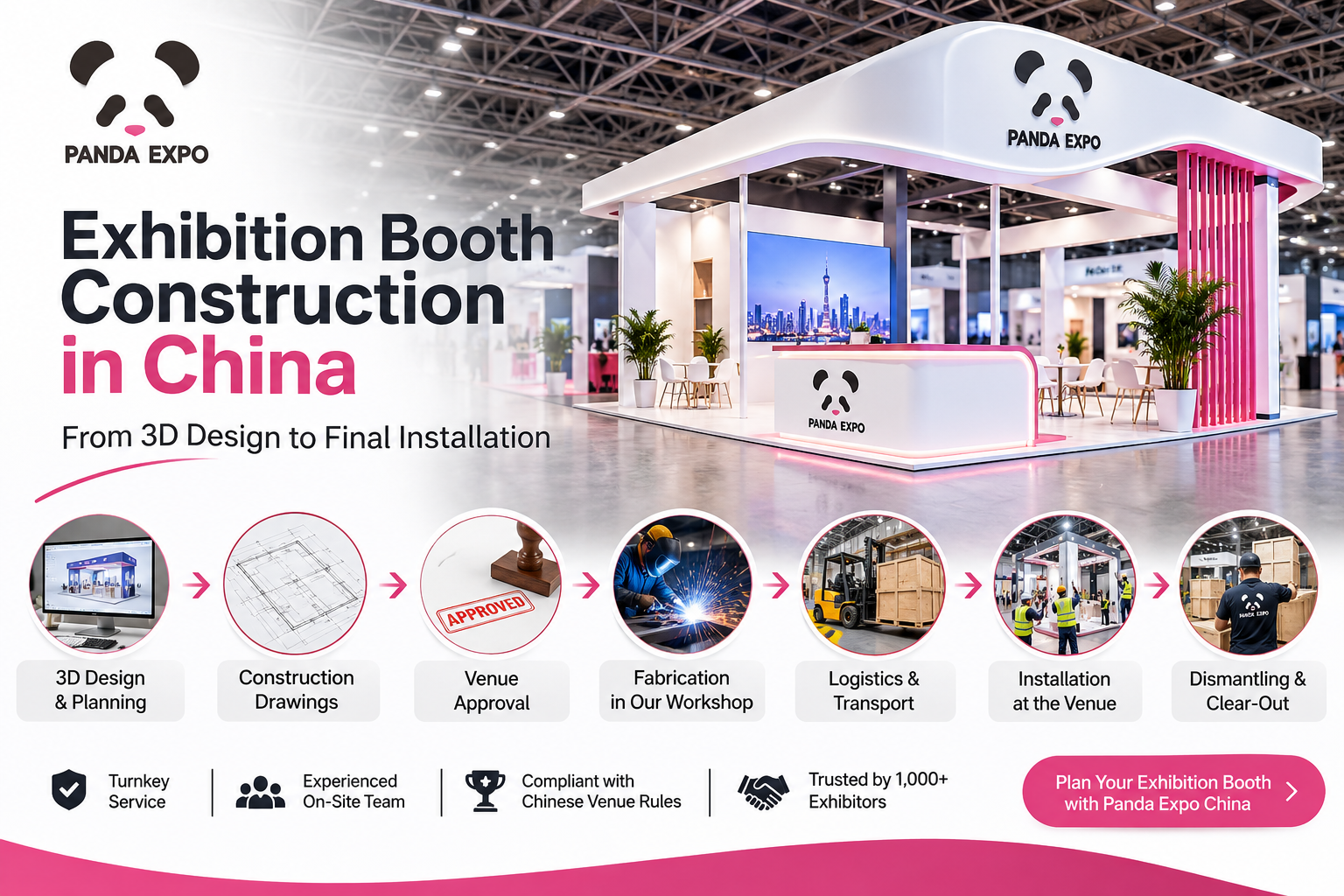

Exhibition booth construction in China is the work that turns an approved 3D design into a finished booth on the show floor. It covers venue-approved drawings, fire-rated materials, fabrication, transport into the hall, installation and, once the show ends, dismantling and clear-out. With a turnkey team, one contact runs all of it. You’re not chasing separate suppliers between the design studio and the hall.
Here’s how we run it at Panda Expo China, and where you’ll need to sign off.
What Exhibition Booth Construction in China Covers
| Stage | What happens | What you provide or approve | Who handles it |
| 3D visual | The booth concept is shown in 3D | Brand files, product list, sign-off on the visual | Our design team |
| Construction drawings | The design becomes dimensioned plans, elevations and material specs | Final approval before submission | Us |
| Venue approval | Drawings and safety forms go to the organizer or its official contractor | Booth number and exhibitor details | Us |
| Fabrication | Structure, finishes and graphics are produced | Final graphic artwork | Our workshop |
| Logistics | The booth is packed and moved to the venue | Your own exhibit products and samples | Us |
| Installation | The booth is built in the hall during build-up | A walk-through before opening | Our on-site team |
| Dismantling | The booth comes down and the space is cleared | Packing your own products | Our on-site team |
Every exhibition stand booth goes through these stages, whatever its size.
From 3D Visual to Build-Ready Drawings
A 3D visual sells the idea. It doesn’t tell a carpenter where to cut, and it doesn’t tell the venue whether the booth is safe.
Once you approve the exhibition stand design, we turn it into construction drawings. These fix exact dimensions, wall heights, materials, lighting positions and where power comes in. Changes are cheapest at this point, not in the hall.
What Chinese Venues Ask For
Each show sets its own requirements, usually in the exhibitor manual. As an example, the space-only rules for a show at the Shanghai New International Expo Centre (SNIEC) asked for:
- A dimensioned plan view and elevations showing heights
- Details of walls, platforms and graphics
- Materials and fire protection details
- A signed health and safety declaration and a risk assessment
- Drawings sealed by a registered structural engineer for platforms over 1.2 m or multi-deck builds, plus calculations for anything above 4 m
Plans had to be approved before contractor badges were issued. No approval, no access.
Height Limits Change by Show and Booth Size
At that same show, booths of 24 m² or more could go up to 4.4 m. Smaller ones stopped at 4 m. Other shows set other limits, so we check the current manual before drawings are final.
Choosing Materials That Pass Fire Rules
Fire rules shape exhibition stand construction in China more than almost anything else. In the SNIEC example:
- Construction and decoration materials had to be at least grade B1
- Timber under 25 mm and boards under 18 mm had to be flameproofed
- Fabrics had to be incombustible or backed with compliant material
- Carpet had to be fixed with double-sided tape, not glue or paint
Here’s how our build options compare:
| Custom build | Modular system (MAXIMA, OCTANORM) | Rental booth | |
| Look | Fully bespoke | Clean, system-based | Customized to your brand |
| Reuse | Mostly built for one show | Frames reused across shows | You don’t own or store it |
| Best for | Large raw-space booths and launches | Repeat shows and smaller booths | One-off or first-time shows |
Fabrication in Our Own Workshop
Fabrication, construction and graphics production are part of our turnkey service, carried out by our own team in our workshop. The people who drew your booth are in touch with the people building it. That removes the handoffs where details get lost, and gives you one point of responsibility if something needs fixing.
What to Check Before Your Booth Leaves the Workshop
Whoever builds your booth, ask for confirmation on these before it ships:
- Finishes and colors match what you approved
- Graphics are the right size, color and language
- Counters, shelves and display units match the drawings
- Cable routes and lighting positions are built in
- Parts are labeled and packed by area, so installation moves fast
Getting the Booth into the Hall
We handle transportation and logistics from the workshop to the venue. Hall access in China is tightly controlled. At the SNIEC show mentioned above:
- Every installer needed a contractor badge (RMB 50 each)
- Vehicles needed a pass for a timed 90-minute entry, plus a RMB 300 vehicle pass deposit
- A non-refundable hall management fee of RMB 30 per m² was due before passes were issued
- A refundable contractor deposit applied: RMB 10,000 for booths up to 54 m² and RMB 20,000 above that
Rules and fees change by show and year, so treat these as an example, not a price list.
On-Site Installation: How Build-Up Runs
Build-up time is set by the organizer, and it’s rarely generous. Our on-site project management team runs the installation from delivery through to handover.
Venue rules shape how an exhibition booth goes up. At SNIEC, for example:
- Each stand needed its own electrical mains connection
- Water and compressed air were ordered through the venue’s appointed contractor
- Nothing could hang from the hall structure; rigging came from the venue only
- Debris had to be cleared daily during build-up
Lighting, AV and graphics go in once the structure is up. Before opening, walk the booth with our team.
Dismantling and Clear-Out
The show closes and the clock starts again. Booths have to come down within the organizer’s dismantling schedule, and the space must be left clear of debris and carpet. At the SNIEC show, stands that weren’t cleared on time were charged a fee.
We handle post-show dismantling. A clean clear-out also matters for getting the contractor deposit back.
Exhibition Booth Construction with Panda Expo China
We’ve worked with more than 1,000 exhibitors over 20+ years, and we’re a member of IFES. Our team covers China, including Hong Kong, Macau and Taiwan, and our work includes shows such as CIIE, SIAL China and bauma SHANGHAI.
One team handles your exhibition booth construction from 3D visuals to dismantling. Send us your show name, booth size and brief for a plan and a quote.
FAQs
When should exhibition booth construction start for a show in China?
Work back from the drawing submission deadline in the exhibitor manual. Design and construction drawings must be final before that date.
Who submits booth drawings to the venue in China?
Usually the booth builder. We prepare the drawings and forms and submit them to the organizer or its official contractor for approval.
What fire rating do booth materials need at Chinese venues?
Each show sets its own rules. Many ask for fire-retardant materials, often grade B1 or better. The exhibitor manual lists what’s required for your show.
Is the contractor deposit refundable?
At most shows, yes, as long as the booth matches the approved drawings and the space is cleared on time.
Can a modular exhibition stand booth be reused?
Yes. Systems like MAXIMA and OCTANORM use frames that work across shows. Only the graphics and layout change.