Your cart is currently empty!

Categories
Recent Posts
- How to Choose an Exhibition Booth Designer: Questions to Ask Before You Hire

- How Are Custom Exhibition Stands Designed and Built? A Step-by-Step Guide
- How to Choose an Exhibition Booth Builder in China: A Guide for US Exhibitors
- Unforgettable Moments at Villa Basset: Crafting the France WorldSkills Cocktail Reception
- Semicon Taiwan 2026
Archive
- October 2026
- September 2026
- May 2026
- March 2026
- February 2026
- January 2026
- December 2025
- November 2025
- October 2025
- September 2025
- August 2025
- July 2025
- June 2025
- May 2025
- April 2025
- March 2025
- February 2025
- January 2025
- December 2024
- September 2024
- August 2024
- July 2024
- March 2024
- February 2024
- January 2024
- November 2023
- April 2023
- March 2023
Tags
Air Cargo China BEIJING booth assembling booth builders booth construction booth contractor booth display contractor booth display ideas booth fabrication booth production China booth contractor China International Bicycle Fair 2026 CHINAPLAS CIPS cosmetics trade show China custom booth design Shanghai custom exhibition stand builders custom exhibition stand design custom exhibition stands exhibition exhibition booth construction exhibition booth design exhibition booth designers exhibition stand builder China exhibition stand builder in Shanghai Exhibition Stand Construction EXHIBITION STAND DESIGN exhibition stand designers and builders expo stand builders expo stand design FPD China 2026 Brand Activation glass industry exhibition HONG KONG Panda Expo Panda Expo China Routes Asia 2026 stand builder SHANGHAI SIAL China 2026 stand builder Sports Events in China tradeshow in guangzhou tradeshow in india tradeshow in japan tradeshow in shanghai tradeshow in vietnam Vinexpo Asia Hong Kong 2026 Exhibition Stand Construction
Social Links
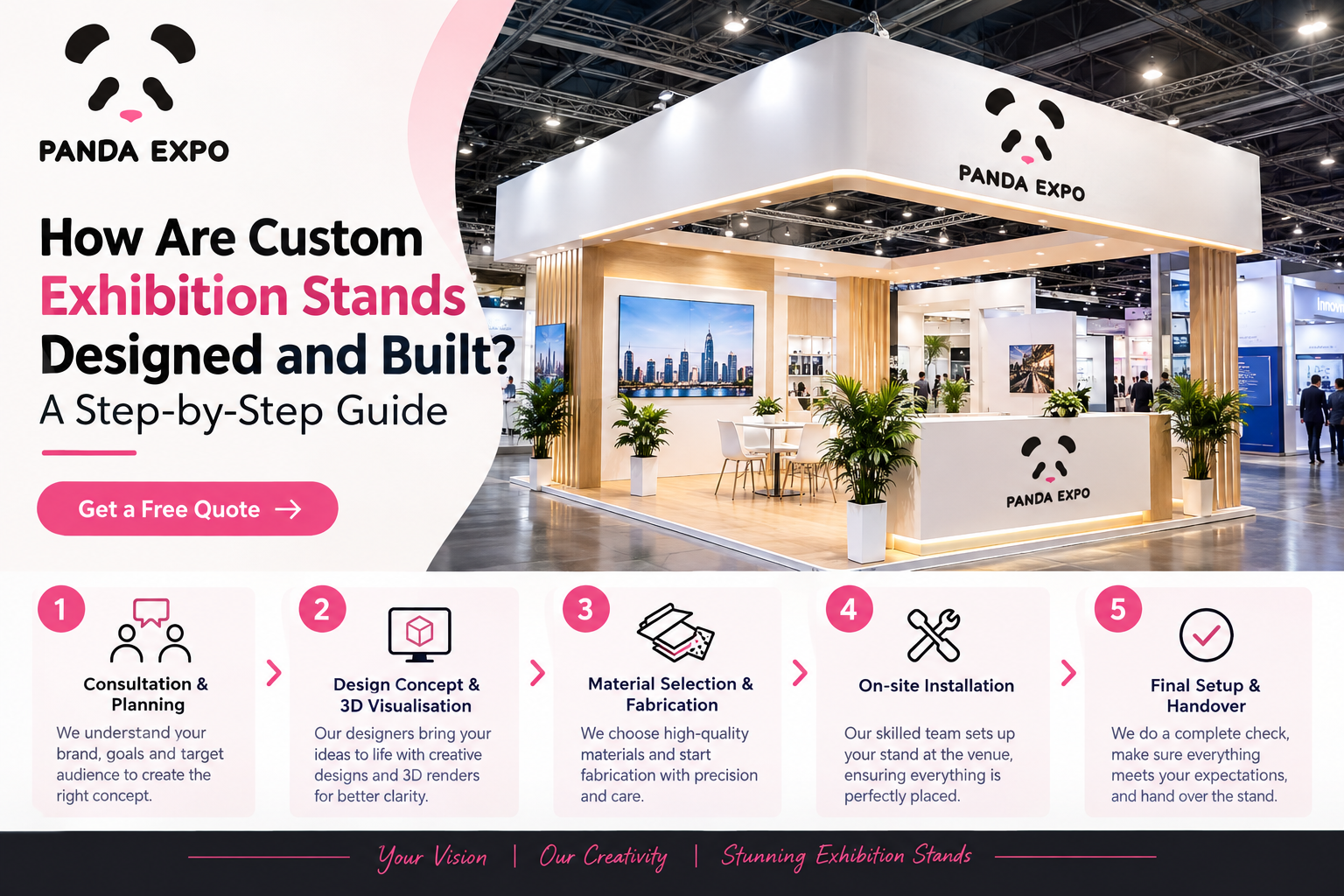

A custom exhibition stand is made in stages. We start with your brief and turn it into a 3D design. Once you approve it, we produce technical drawings and fabricate the structure in a workshop. Graphics get printed, and everything is shipped to the venue, built on the stand space and taken down after the show. Most of the real work happens weeks before the doors open. We ask clients to come to us at least 4–6 weeks before an event, and earlier for large or double-deck builds.
If you’re a US brand exhibiting in China or elsewhere in Asia, Panda Expo China can guide you through the process from initial planning to on-site build.
How Are Custom Exhibition Stands Made? The Short Answer
| Stage | What happens | What you provide |
| Brief | We agree on goals, budget, stand size and must-haves | Show name, stand number, objectives, brand guidelines |
| Design | 3D concept, then revisions | Feedback and sign-off |
| Engineering | Technical drawings and structural checks | Product sizes, AV needs, power needs |
| Fabrication | Structure, flooring, joinery and graphics are produced | Final artwork |
| Logistics | Transport to the venue and timed move-in | Details of any products shipping from the US |
| Build and show | On-site assembly, lighting and AV, then support during the show | Your team on the stand |
| Dismantle | Breakdown, removal and storage of any reusable parts | Nothing. We handle it. |
The Exhibition Stand Design Process, Step by Step
Start with a brief, not a sketch
The brief does most of the work. What do you want from the show? Leads, product launches, distributor meetings and brand visibility all call for different layouts. A stand built for private meetings needs a closed room. One built for foot traffic needs open sides and demo space.
At Panda Expo China, we’ll also ask about budget early. It’s much easier to design to a number than to cut a finished design back to one.
Check the floor plan and venue rules
Every hall has its own rules. Height limits, rigging points, fire ratings, power supply and move-in windows all shape the design. An island stand open on four sides works very differently from an inline booth with one open face.
We check the organiser’s manual before any design work starts. This step gets skipped a lot, and that’s how stands end up redesigned two weeks out.
3D concept and revisions
Next comes the 3D design. You’ll see the stand from the aisle and from above, with your branding, product displays and furniture in place. Most clients go through a round or two of changes here. That’s normal. It’s far cheaper to move a wall in a render than in a workshop.
Engineering and technical drawings
Once the look is signed off, our team turns it into build drawings. That covers structure, load-bearing points, electrical layout, lighting positions and screen mounts. Some venues need these drawings submitted for approval, and we prepare those too.
Fabrication and graphics
This is where custom exhibition stands become real. Walls, counters, flooring and feature pieces are cut and finished. Graphics are printed and test-fitted where possible. For clients who want to reuse parts, we often combine custom joinery with modular systems like OCTANORM or MAXIMA.
At Panda Expo China, everything goes to the venue in a planned order. Our crew builds the stand during the organiser’s set-up window, then installs lighting and AV and runs final checks. During the show we stay on call for fixes. Afterwards, we dismantle and clear the space before the hall’s deadline.
Shipping, build-up and dismantle
Everything goes to the venue in a planned order. Our crew builds the stand during the organiser’s set-up window, then installs lighting and AV and runs final checks. During the show we stay on call for fixes. Afterwards, we dismantle and clear the space before the hall’s deadline.
Custom Exhibition Stand Cost Factors
No two quotes look alike. Here’s what moves the price most:
- Stand size and layout. More square metres and more open sides mean more structure and more finishing.
- Height and double-deck builds. Second floors need engineering, approvals and extra labour.
- Materials and finishes. Painted timber, high-gloss panels, fabric walls and glass all cost differently.
- Lighting and AV. LED walls, touchscreens and rigged lighting add up fast.
- Bespoke features. Curved walls, product plinths and branded reception desks take longer to build.
- Large-format prints, backlit fabric and floor graphics each carry their own costs.
- Venue charges. Power hook-ups, rigging and cleaning are often billed by the organiser, separately from the build.
- A modular-hybrid stand costs more up front but saves on later shows.
- Lead time. Rushed jobs mean overtime and express freight.
Want the budget to go further? Spend on what visitors actually notice, like lighting, the main graphic wall and a good meeting area. Save on hidden structure.
Building a Stand in China as a US Exhibitor
Shipping a full stand across the Pacific is slow and expensive, and it brings customs paperwork. Building locally avoids most of that. Our team works across mainland China, Hong Kong, Taiwan and much of Southeast Asia. We know the venues, the suppliers and the move-in rules.
For most US clients, the only things that travel are products and sometimes a few brand pieces. The rest is made close to the show. That cuts freight costs and gives us more room to fix things on site if plans change. With 20 years of building stands and over 1,000 exhibitors served, we’ve seen most of the surprises a show can throw at a team.
FAQs
How long does it take to design and build a custom exhibition stand?
Plan for at least 4–6 weeks from brief to show day. Bigger or double-deck stands need more time, especially when venue approvals are involved.
What’s the difference between a custom stand and a modular stand?
A custom stand is designed and built from scratch for your brand and space. A modular stand uses reusable frame systems. Many of our builds mix the two.
Can I reuse my custom stand at another show?
Yes, if we plan for it at the design stage. Modular frames and storable feature pieces make reuse much easier.
Do I need to ship anything from the US?
Usually just your products, samples and printed sales material. We fabricate the stand itself locally.
Who deals with the organiser’s approvals?
We do. We prepare the technical drawings and submit them to the organiser in line with the venue’s rules and deadlines.