Your cart is currently empty!

Categories
Recent Posts
- Best Trade Show Booth Displays for Healthcare and Medical Companies
- Exhibition Booth Construction in China: From 3D Design to Final Installation
- 2027 WorldSBK China Finale | Event Services in China
- How to Find a Reliable Exhibition Stand Builder in China: A Complete Guide for Overseas Exhibitors
- Exhibition Booth Design for Electronics Trade Shows in China: A Planning Guide for US Brands
Archive
- November 2026
- October 2026
- September 2026
- May 2026
- March 2026
- February 2026
- January 2026
- December 2025
- November 2025
- October 2025
- September 2025
- August 2025
- July 2025
- June 2025
- May 2025
- April 2025
- March 2025
- February 2025
- January 2025
- December 2024
- September 2024
- August 2024
- July 2024
- March 2024
- February 2024
- January 2024
- November 2023
- April 2023
- March 2023
Tags
Air Cargo China BEIJING booth construction booth display ideas booth fabrication booth management booth production brand communication CHINAPLAS CIPS custom exhibition stand builders custom exhibition stand design custom exhibition stands exhibition exhibition booth construction exhibition booth design exhibition booth designers exhibition stand booth exhibition stand builder China exhibition stand builder in Shanghai Exhibition Stand Construction exhibition stand contractor EXHIBITION STAND DESIGN exhibition stand designers and builders expo stand builders expo stand design FPD China 2026 Brand Activation HONG KONG Hotel & Shop Plus Panda Expo Panda Expo China Routes Asia 2026 stand builder SHANGHAI SIAL China 2026 stand builder SNIEC Shanghai Sports Events in China tradeshow booth trade show booth displays tradeshow display tradeshow in guangzhou tradeshow in india tradeshow in japan tradeshow in shanghai tradeshow in vietnam Vinexpo Asia Hong Kong 2026 Exhibition Stand Construction
Social Links
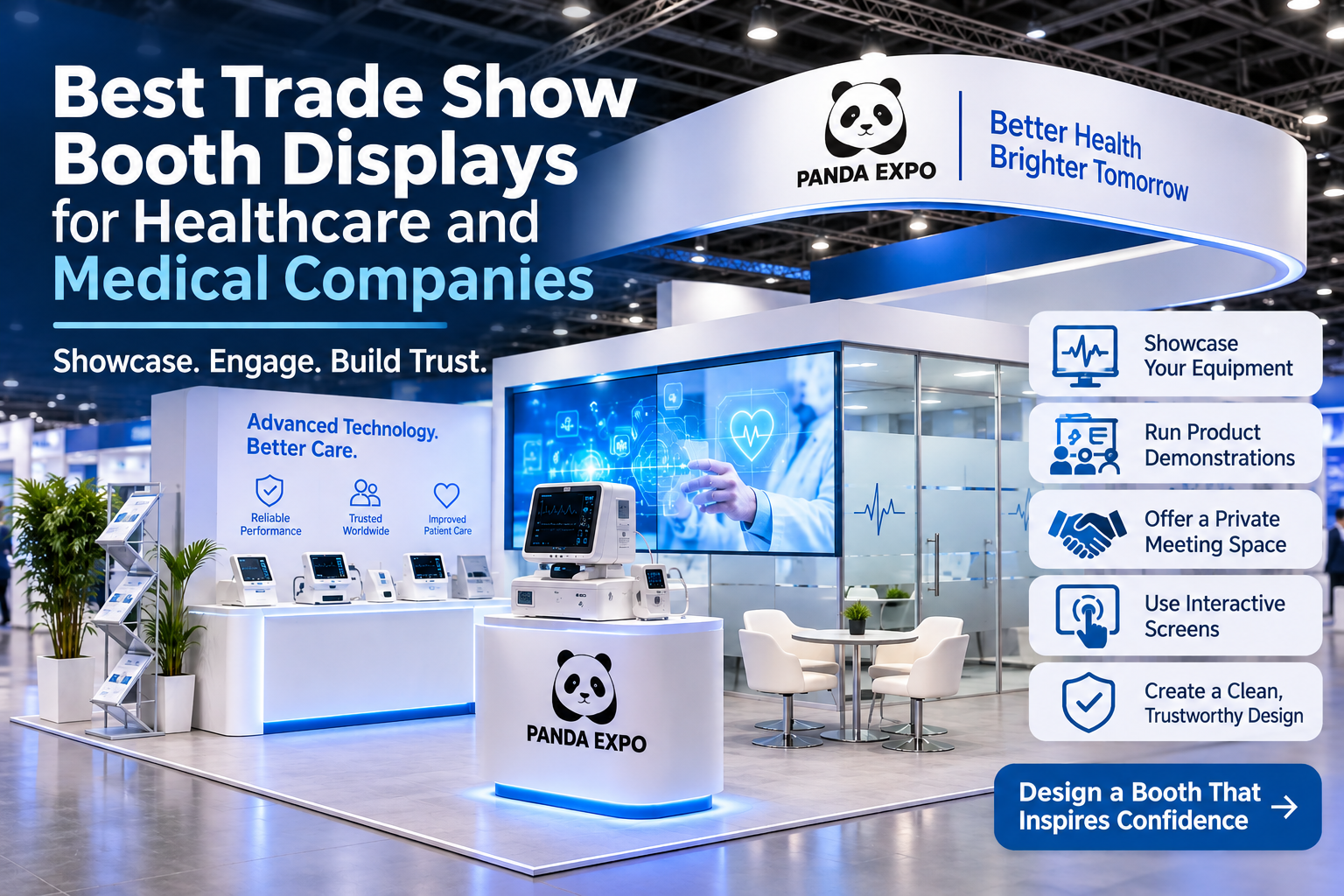

The best trade show booth displays for healthcare and medical companies are clean, well lit and built around the product. They give equipment room to be seen and handled, set aside a proper demo area, keep a private space for sensitive conversations, and use screens to explain what a device actually does. The whole booth should feel calm and trustworthy, because that’s what visitors expect from a medical brand.
Below, we go through each part of a healthcare booth, with practical examples you can use at shows like CMEF (China International Medical Equipment Fair) in Shanghai.
What Healthcare Visitors Expect from Trade Show Booth Displays
Medical shows draw a mixed crowd. Most of them want detail, not hype. A good tradeshow booth earns trust at a glance, then supports longer technical conversations.
| Visitor | What they want | What the booth needs |
| Clinicians | To see and handle the device | Demo stations, products at working height |
| Hospital procurement teams | Specs, service terms, pricing | Seated meeting space, clear spec sheets |
| Distributors | Partnership terms | A private meeting room |
| Engineers and technicians | How it works inside | Cutaways, screens with technical detail |
Design for all four, and the layout mostly falls into place.
Displaying Medical Equipment and Healthcare Products
Large Equipment
Imaging systems, hospital beds and surgical units need floor space and clear sightlines. Put them on a low platform with room to walk all the way around. Check weight, power needs and the delivery route early. A large unit needs a clear path into the hall and onto your booth.
Small Devices and Consumables
Small products vanish on a big booth. Lit display cases, eye-level plinths and enlarged graphics help. A screen showing a close-up does even more. Lock any case holding high-value or pre-launch items.
Example: A company launching a portable ultrasound puts one unit on a central plinth under a spotlight. A screen behind it shows live scan images. Two hands-on units sit at a demo counter to the side.
Product Demonstration Areas That Work
Demos are where interest turns into leads. A few things make them work:
- Standing-height counters, so the demonstrator and visitor work side by side
- Hidden power and data cabling, with more outlets than you think you’ll need
- Room for a small group to watch without blocking the aisle
- A screen that mirrors the device display, so the crowd can see too
- Simulation models or training mannequins for procedures you can’t show live
- Wipe-clean surfaces and hand sanitizer at every station
One more point. If a product isn’t yet approved in the market where the show is held, check with your regulatory team what you can show and say, and label it clearly.
Clean, Professional and Functional Booth Layouts
Healthcare brands look strongest with restraint. Light surfaces, one or two brand colors and plenty of open space. Clutter suggests carelessness, which is the opposite of the message you want.
Zoning the Floor
| Zone | Where it sits | What it does |
| Hero display | Front, facing the main aisle | Stops people walking past |
| Demo area | Side or corner, open access | Hands-on testing |
| Screen wall | Back wall | Explains the product and brand |
| Meeting room | Rear, semi-closed | Private talks |
| Reception and storage | Near the entrance, storage hidden | Lead capture and stock |
Materials and Finishes
Choose matte, wipe-clean finishes. Use soft, even lighting, and angle it so screens don’t catch glare. Raised flooring hides cables and keeps the floor safe for visitors. In China, materials also have to meet the venue’s fire rules, which a local booth construction team will plan for.
Private Meeting and Consultation Spaces
A lot of medical business starts with a confidential talk. Tender pricing, distribution terms, clinical data. An open counter isn’t the place for any of it.
Your options depend on space:
- Closed meeting room: a door, a table for four to six people and a screen
- Semi-private pods: frosted panels for shorter conversations
- Two-level booth: meetings upstairs on large raw-space booths, where the venue allows it and structural approval is in place
Example: On a 54 m² island booth, a 9 m² meeting room at the back, with frosted graphics on its glass, keeps talks private while the front stays open and welcoming.
Interactive Screens and Digital Displays
A digital tradeshow display explains what visitors can’t see: the inside of a device, how a treatment works, or outcomes data.
- Touchscreens and digital kiosks let visitors browse product ranges and specs at their own pace
- LED video walls carry the brand story and are visible from the aisle
- AR or VR can place a device in a clinical setting or walk through a procedure step by step
- QR codes link to brochures and data sheets, so you print less
Keep videos short, silent and captioned. At shows in China, use English and Simplified Chinese on screens and key graphics.
Branding and Visitor Engagement
Strong branding on a medical booth is clear rather than loud. Give each wall one headline that’s readable from the aisle. Use brand colors consistently, not everywhere.
Engagement comes from what happens on the booth:
- Short, scheduled demos posted on a sign at the front
- Brief talks by a clinician or product specialist
- A seating area for longer conversations
- Badge scanning, with each lead tagged by type so sales can follow up properly
A trade booth display that people stop at, sit in and remember does more than one that’s simply bigger.
Custom Exhibition Stands or Modular Systems?
| Custom exhibition stands | Modular system (MAXIMA, OCTANORM) | Rental booth | |
| Best for | Launches and large raw-space booths | Repeat shows and smaller booths | One-off or first-time shows |
| Design freedom | Full | Set by the frame | Customized to your brand |
| Reuse | Mostly built for one show | Frames reused across shows | Not owned or stored |
Many medical brands start modular and move to custom exhibition stands once a show becomes a fixed part of their calendar.
How Panda Expo China Supports Healthcare Exhibitors
We’ve worked with more than 1,000 exhibitors over 20+ years, and we’re a member of IFES. Our clients include biopharma company Zai Lab, and our team covers China, including Hong Kong, Macau and Taiwan, and other markets across Asia.
As custom exhibition stand builders, we design and build trade show booth displays with the whole job in one place: design and 3D visuals, fabrication, graphics, lighting and AV, logistics, installation and dismantling. Planning a booth for your next medical show? Send us your show name, booth size and product list, and we’ll come back with ideas and a quote.
FAQs
What should a medical trade show booth display include?
A clear hero product, a hands-on demo area, screens that explain the product, a private meeting space and a reception point for lead capture. Smaller booths combine some of these.
How do I display large medical equipment at a trade show?
Give it a low platform, space to walk around it and good lighting. Confirm weight, power and the delivery route with your booth builder well before the show.
Do healthcare booths really need a private meeting room?
If you’re talking pricing, tenders or distribution, yes. Even a small semi-closed corner makes those conversations easier.
Which digital displays work best for medical products?
Touchscreens for specs, LED walls for visibility from the aisle, and AR or VR for showing devices in use. Keep content short and bilingual for international shows.
Can a modular tradeshow display work for a medical company?
Yes. Modular systems give a clean, professional look and can be reused across shows. A custom demo area or meeting room can sit inside a modular frame.